MOTS-c side effects: what is actually known about its safety in people
The short answer
Nobody can list MOTS-c side effects with confidence, because no completed human trial of MOTS-c itself has published safety results. The closest data come from CB4211, a MOTS-c analog, where the company reported no serious adverse events over four weeks and injection site reactions as the main problem. Long-term effects in people are unknown.
MOTS-c has a loud fan base in the longevity world and a very quiet safety record. That is not because it has been tested and found to cause problems. It is because it has barely been tested in people at all. This page says that plainly, then lays out everything that does exist: one completed trial of a MOTS-c analog, a handful of mouse studies, a phase 2a trial that is still recruiting, and what people on X are saying. Every research statement links to its source, and the community reports are kept separate from the evidence.
What are the side effects of MOTS-c?
The honest answer is that nobody knows the side effect profile of MOTS-c in people, because no completed human trial of MOTS-c itself has posted safety results. The closest evidence is a phase 1 trial of CB4211, a drug developed from MOTS-c, where the sponsor reported no serious adverse events and injection site reactions as the most common problem. Everything else people describe online is personal report, not measured data. So any list of “MOTS-c side effects” you see is either borrowed from the analog trial or anecdotal.
What does MOTS-c do?
MOTS-c is a 16-amino-acid peptide encoded in mitochondrial DNA that, in mice, prevented diet-induced and age-related insulin resistance and diet-induced obesity. It is thought to work through AMPK, the cell’s energy sensor, mainly in skeletal muscle. In people, one exercise study found that a cycling session raised the body’s own MOTS-c, but taking it has not been shown to do anything yet. Our full guide to the MOTS-c metabolic research covers the benefits side, and the hub’s MOTS-c overview covers the basics.
What human safety data exists for MOTS-c?
The human safety evidence for MOTS-c is thin: one small, completed trial of an analog, reported by the company, and one trial of MOTS-c itself that has not finished. A 2026 narrative review in Sports Medicine that covered MOTS-c alongside other approved and unapproved peptides put it bluntly: many unapproved peptides look good in animal models, but rigorous human safety data are scarce, and there is potential for serious harm. A 2023 review in Frontiers in Endocrinology likewise noted that no effective method of applying MOTS-c in the clinic has been developed.
Here is the whole human picture in one table. Evidence level: one small analog trial with company-reported results, no peer-reviewed human safety study of MOTS-c itself.
| Study | What was given, to whom | How long | What it says about safety |
|---|---|---|---|
| CB4211 phase 1a/1b, NCT03998514 | CB4211 (a MOTS-c analog, not MOTS-c) or placebo by injection under the skin; 88 healthy adults and adults with fatty liver disease | Single doses, 7 daily doses, or 28 daily doses depending on the group | Completed 2021; no results posted on the registry. The sponsor’s press release reported no serious adverse events, with transient, generally mild to moderate injection site reactions as the only adverse events in more than 10% of CB4211 recipients in the four-week part. |
| MOTS-c phase 2a, NCT07505745 | MOTS-c or placebo, once daily by injection under the skin, in an estimated 120 adults with prediabetes and overweight or obesity | 12 weeks of treatment, safety follow-up to week 16 | Recruiting; registry start date February 2026. Its primary outcomes include treatment-emergent adverse events, and anti-drug antibodies are a secondary outcome. No results yet. |
| Reynolds 2021, Nature Communications | Nothing; ten young men did one cycling session | One exercise bout | None. It measured the body’s own MOTS-c rising after exercise, which says nothing about taking it. |
What side effects did the MOTS-c analog trial report?
The only human side effect signal on record is injection site reactions, and it comes from CB4211, a modified version of MOTS-c rather than the peptide people buy. In November 2018 the sponsor, CohBar, paused the trial to address mild injection site reactions that were unexpectedly persistent, describing them as painless bumps under the skin and saying some of the dose appeared to persist where it was injected. After the trial resumed and finished, the company’s August 2021 release said the only adverse events in more than 10% of people on CB4211 during the four-week phase were transient, generally mild to moderate injection site reactions, with no serious adverse events. That four-week comparison involved 11 people on the 25 mg dose and 9 on placebo.
Three caveats keep this in proportion. These are company-reported topline results, not a peer-reviewed paper, and the registry still shows no posted results. CB4211 is a different molecule from MOTS-c, so its tolerability does not transfer automatically. And four weeks in about 20 people cannot pick up rare or long-term effects.
What did the mouse studies show about safety?
The mouse studies were designed to measure benefits, not to hunt for harms, so they tell you little about side effects. The 2015 founding study treated mice for seven days in its insulin-sensitivity tests and eight weeks in its high-fat-diet obesity experiment. In the 2021 Nature Communications study, old mice treated three times a week from late life had comparable body weight to untreated mice, but significantly lower total food intake and higher activity. Lower food intake is a real physiological effect worth knowing about, but it was reported as a finding, not as a side effect, and it was in mice. A 2023 review in the Journal of Translational Medicine sums up the state of the field: “there are still many questions that remain unclear”.
Who should be cautious about MOTS-c?
The people with the most reason for caution are the groups nobody has studied, and the current MOTS-c trial’s exclusion list is a useful map of them. The phase 2a trial excludes people with diabetes, people on glucose-lowering drugs (including metformin and GLP-1 drugs), people with recent serious heart disease or uncontrolled blood pressure, reduced kidney function or significant liver disease, active cancer needing treatment, and anyone pregnant or breastfeeding. Exclusion does not prove harm in those groups. It means researchers chose not to expose them until they know more, which is a reasonable signal for anyone outside a trial too. Because MOTS-c is studied for its effect on blood sugar handling, people on glucose-lowering medicines have a specific reason to talk to a clinician first.
How long can I take MOTS-c?
No study has established how long MOTS-c can be taken safely, because no human study has dosed it for long. Here is what research has actually used, reported for context, not as a recommendation:
- Mice: seven days for insulin-sensitivity tests and eight weeks in the high-fat-diet experiment in the 2015 founding study; two weeks of daily treatment in young mice, and three times a week from late life onward in old mice, in the 2021 study.
- The analog, CB4211: single doses, seven days, or 28 days in the phase 1 trial.
- MOTS-c itself: 12 weeks of once-daily treatment with follow-up to week 16 in the phase 2a trial, which has not reported.
So the longest human exposure in the published record we found is four weeks of an analog. Anyone running MOTS-c for months is past anything that has been measured in people.
Does MOTS-c burn visceral fat?
There is no human evidence that MOTS-c burns visceral fat. In mice it prevented diet-induced obesity, and old treated mice showed reduced total fat mass, but no completed human trial has measured fat loss on MOTS-c. Our sister site’s evidence-ranked guide to peptides for weight loss puts MOTS-c next to the approved options.
How does MOTS-c compare with other longevity options on safety data?
MOTS-c sits at the thin end of the safety evidence among popular longevity tools. The table compares what kind of human data exists, not which option is better.
| Option | Human safety data in one line | Where to read more |
|---|---|---|
| MOTS-c | No published safety results for MOTS-c itself; one small analog trial, company-reported | This page |
| NAD+ precursors | Small, short randomized trials; NR was well tolerated over six weeks in a crossover trial that randomized 30 healthy adults aged 55 to 79 | NAD+ vs peptides for longevity |
| Rapamycin | Approved as sirolimus (Rapamune) with a full FDA prescribing label for kidney-transplant rejection and lymphangioleiomyomatosis; longevity is not a labeled use | Rapamycin vs peptides for longevity |
In community discussion MOTS-c is rarely taken alone. Users commonly pair it with SS-31, another mitochondria-targeted peptide, and some fit it into wider routines with NAD+, GHK-Cu or GLP-1 peptides, timed around fasting and training. No trial has tested any of these combinations, so each stack adds unknowns rather than removing them.
What does MOTS-c cost?
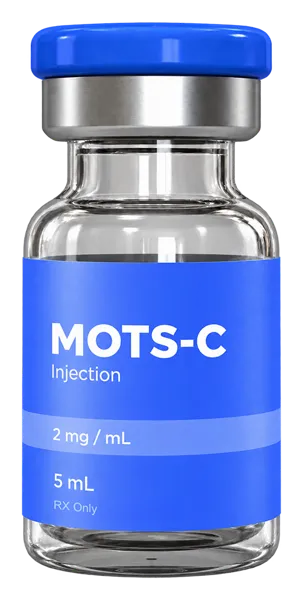
MOTS-c carries the highest list price in the catalog of the storefront in this page’s “Where it’s sold” card. The price captured on October 12, 2026 was $619 a month on a one-month plan or $565 a month on a three-month plan, for a product listed as a 2 mg/mL injectable in a 5 mL vial. Prices change, so treat that as a dated snapshot, and weigh it against how little is known about long-term use.
What is the community saying about MOTS-c side effects?
Side effects barely come up in the community conversation, which is mostly about energy, stacking and hype. Our MOTS-c community tracker, drawn from 19 public posts on X collected in July 2026, found these recurring threads:
- Energy and mitochondria. Many posts describe MOTS-c as a mitochondrial peptide for cellular energy, and some users report noticeable improvements. These are personal characterizations, not measurements.
- The SS-31 question. Users debate whether to run MOTS-c and SS-31 together or one after the other, sharing their own N=1 order with no consensus.
- Hype skepticism. One commenter lumped MOTS-c in with trend-chasing, while another said he expected to dismiss it and revisited that view after a month of daily use.
Read the silence on side effects carefully. A small sample of enthusiastic posts is not a safety signal in either direction, and the Sports Medicine review cited above specifically discusses the placebo effect and how social media amplifies it in peptide culture. Absence of complaints on X is not the same as absence of harm.
Status: Not FDA-approved; sold by some telehealth providers as a compounded prescription. An FDA advisory committee reportedly voted in July 2026 to recommend allowing pharmacies to compound it; nothing has changed yet. (How peptide status works)
How this page is sourced
Every research statement on this page links to a primary paper, a review, a trial registry entry or a company release or filing. The mouse findings come from the 2015 Cell Metabolism study and the 2021 Nature Communications study; the review-level context comes from the 2023 Journal of Translational Medicine review, the 2023 Frontiers in Endocrinology review and the 2026 Sports Medicine review. Trial designs come from ClinicalTrials.gov entries NCT03998514 and NCT07505745, and the CB4211 safety reports come from CohBar’s 2018 SEC filing and 2021 press release. The community summary comes from our own dated collection of public posts. This piece is drafted with AI assistance and fact-checked against its cited sources.
Educational information only, not medical advice. Every evidence statement on this page is sourced to the documents linked above. Updated October 12, 2026.
Sources (11)
Advertising disclosure: links marked "Paid link" go to Bodybuilding Peptides (trybbpeptides.com), an affiliate destination, and Healthspan Signal may earn a commission if you buy there. Our coverage is independent of that relationship, and nothing on this page is medical or legal advice.
 See it at Bodybuilding Peptides