NAD+ vs peptides for longevity: what the evidence says

The short answer
NAD+ precursors (NR and NMN) have the better human evidence: small trials show they raise NAD+ and move a few metabolic markers, though a 2026 study found blood NAD+ does not track aging. Longevity peptides such as MOTS-C and epitalon rest mainly on mouse and cell studies. Neither has been shown to extend human healthspan.
NAD+ precursors and longevity peptides are competing pitches for the same customer, and neither has earned the certainty its marketing projects. This page compares the two honestly on evidence, biomarkers and risk, covers where 5-Amino-1MQ fits and how people stack them, and ends with the one next step that is actually useful.
How NAD+ precursors and longevity peptides differ
NAD+ precursors and longevity peptides are two different bets on the same goal, and telling them apart starts with what each molecule is trying to do. NAD+ precursors, most commonly nicotinamide riboside (NR) and nicotinamide mononucleotide (NMN), are small molecules the body converts into NAD+, a coenzyme central to energy metabolism and DNA repair that is widely reported to decline in some tissues with age. The theory is simple: top up the raw material, restore NAD+, and support the cellular machinery that flags with aging. Longevity peptides are short amino-acid chains with more specific mechanistic stories. MOTS-C is a mitochondrial-derived peptide studied for metabolic and exercise-related effects; epitalon (epithalon) is a synthetic tetrapeptide marketed on a telomerase-activation story. The categories differ in three ways that matter to a buyer: the strength and type of human evidence behind them, whether the biomarker each is sold on is actually meaningful, and how much is known about their safety. The rest of this page takes those one at a time.
What the human evidence shows for NAD+ precursors (NMN and NR)
NAD+ precursors reliably raise NAD+ in the body, but the human trials that exist are small, short, and stop well short of proving a longevity benefit. The best-known NR trial was a 2×6-week randomized, double-blind, placebo-controlled crossover study in 30 healthy adults aged 55 to 79; it concluded that “oral NR supplementation effectively elevated levels of NAD+ in PBMCs by ~60% compared with placebo” and that “chronic oral supplementation with 1000 mg per day of NR is a well-tolerated and effective strategy for stimulating NAD+ metabolism in healthy middle-aged and older humans” (Martens et al., 2018). Crucially, the same authors were candid that the clinical signals were not established: NR “tended to lower” blood pressure and arterial stiffness, but “these comparisons were not statistically significant after correction for multiple comparisons,” and the physiological outcomes were “designed to be exploratory in nature.”
The most-cited NMN trial is similar in shape. Over 10 weeks, 25 postmenopausal women with prediabetes took 250 mg/day of NMN or placebo; muscle insulin sensitivity “was 25±7% greater after than before 10 weeks of NMN supplementation (p<0.01)” (Yoshino et al., 2021). That is a real, single, mechanistically interesting result, and the same study reports how narrow it was. Body composition, blood pressure, and plasma glucose, insulin, and lipids “did not change in either group after 10 weeks of treatment,” and, tellingly, “muscle NAD+ and nicotinamide content did not change after 10 weeks of treatment in either group.” In other words, the one positive endpoint appeared without a measurable change in tissue NAD+, in one sex, in one metabolic subgroup, over ten weeks. Both trials are legitimate science and both point the same way: NAD+ precursors are well tolerated and they move a lab value, but no human study has shown they extend lifespan, slow aging, or prevent age-related disease.
Is blood NAD+ even a good marker of aging?
Blood NAD+ is a shakier marker of aging than the marketing implies, and this is the single most important caveat in the whole NAD+ story. The entire category rests on the premise that NAD+ falls with age and that raising it is therefore rejuvenating. But a 2026 study that measured NAD+ across seven independent human cohorts using validated mass spectrometry found that “whole-blood NAD+ levels remain remarkably stable with age and across lifestyle interventions,” even as the same assay confirmed NAD+ “change in response to nicotinamide riboside supplementation, as expected.” The authors’ conclusion is blunt: “Our results challenge the utility of blood NAD+ levels as a biomarker of ageing or lifestyle factors” (Trętowicz et al., Nature Metabolism, 2026).
The picture from earlier work was already messy rather than clean. A 2022 analysis of whole-blood NAD+ in 1,518 people (mean age 43) found that “the level of NAD+ did not significantly differ among five groups in total population,” detecting only an inconsistent, sex-dependent decline, an inverse association in men that reached significance after age 60, and a fluctuating pattern in women (Yang et al., Frontiers in Endocrinology, 2022). None of this means NAD+ biology is unimportant; direct tissue measurements in muscle, skin, and other organs still show age-related decline, and NAD+ metabolism is a serious research field. What it means is narrower and more useful to a buyer: the specific blood number that supplement marketing invokes is a poor stand-in for your biological age, so “raises your NAD+” is not the same claim as “slows your aging,” and a rising blood NAD+ level does not prove either that you were deficient or that you are now younger.
What the evidence shows for longevity peptides (MOTS-C and epitalon)
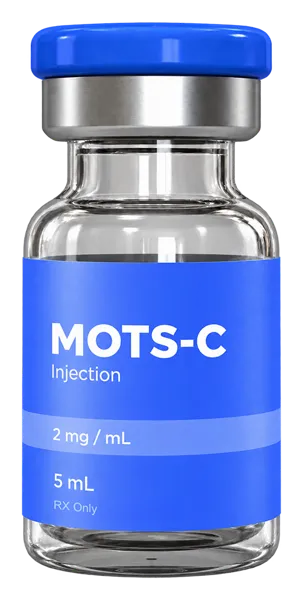
The strongest longevity data for MOTS-C and epitalon come from mice and cell cultures, not from human trials, which places them a rung below the NAD+ precursors on human evidence. MOTS-C was first described as a “16-amino-acid peptide” encoded within “the mitochondrial 12S rRNA” that “regulates insulin sensitivity and metabolic homeostasis,” acting through the energy sensor AMPK in mice (Lee et al., 2015). A 2021 study built the “exercise peptide” reputation, reporting that “MOTS-c can significantly enhance physical performance in young (2 mo.), middle-age (12 mo.), and old (22 mo.) mice” and that “late-life initiated intermittent MOTS-c treatment (3x/week) can increase physical capacity and healthspan in mice” (Reynolds et al., 2021). Its human data amount to a biomarker observation, not a treatment result: in people, circulating MOTS-C rose “during (1.6-fold) and after (1.5-fold) exercise,” which shows exercise raises the body’s own MOTS-C, not that injecting it makes anyone healthier. PeptideAgent’s NAD+ vs MOTS-c comparison also favors NAD+ on human evidence, with one caveat worth knowing: the injectable and intravenous NAD+ that clinics sell has only an 11-person pharmacokinetic pilot behind it.
Epitalon’s case is thinner and older. Its anti-aging reputation traces almost entirely to a 2003 experiment in which the peptide reactivated telomerase and lengthened telomeres in human fetal cells in a dish; the authors interpreted this as evidence that “indicates the possibility of prolonging life span of a cell population and of the whole organism” (Khavinson et al., 2003). That sentence was written about cultured cells, and no rigorous human trial has closed the gap between “lengthens telomeres in a dish” and “extends a person’s healthspan.” Our companion pillar on epitalon and cellular aging walks through why the impressive-sounding human numbers attached to it actually came from a different substance. The honest summary for both peptides: interesting mechanisms, real preclinical signals, and no completed human longevity trial to support the promises made online.
NAD+ precursors vs longevity peptides at a glance
The table below sets the two categories side by side on the dimensions a buyer actually cares about, so the evidence level is visible rather than blurred by marketing. No row should be read as a recommendation; none of these is a proven anti-aging therapy.
| Dimension | NAD+ precursors (NMN, NR) | Longevity peptides (MOTS-C, epitalon) |
|---|---|---|
| What it is | Small molecules the body converts into NAD+ | Short synthetic/mitochondrial peptides |
| Best human evidence | Small, short RCTs: NR raised NAD+ ~60% (n=30); NMN raised muscle insulin sensitivity 25±7% (n=25) | Human data limited to an exercise-biomarker observation (MOTS-C); none for epitalon |
| Best mechanistic/preclinical data | NAD+ biology in cells and rodents | Mouse performance/healthspan (MOTS-C); in-vitro telomerase (epitalon) |
| Proven to extend human lifespan/healthspan | No | No |
| Biomarker it is sold on | Blood NAD+, which a 2026 seven-cohort study found does not track aging | Telomere length / performance markers, not validated longevity endpoints in humans |
| How it is taken | Oral supplements (NMN’s supplement status was restored in Sept 2025) | Mostly injections |
| Main practical risk | Modest, mostly benign; efficacy overstated | Thin human safety data; product quality varies by source |
The row that reframes the whole comparison is the biomarker line. Both categories are sold on a number, a blood NAD+ level or a telomere length, that has not been established as a reliable measure of how fast a person is aging. A therapy can move its favorite marker and still do nothing for your healthspan, and that gap is where most of the marketing lives.
Where does 5-Amino-1MQ fit between NAD+ and peptides?
5-Amino-1MQ often comes up in the same conversations, and it sits in an odd spot between the two categories: it is marketed alongside peptides but is actually a small molecule, and its mechanism runs through NAD+. It belongs to a family of compounds that block NNMT, an enzyme involved in nicotinamide metabolism. In the main published study, NNMT inhibitors raised intracellular NAD+ and suppressed fat formation in cultured fat cells, and over an 11-day experiment, obese mice on a high-fat diet given 5-amino-1MQ lost 5.1% of their body weight while untreated mice gained 1.4%, with no difference in food intake and roughly 35% less of one white-fat depot (Neelakantan et al., 2018). Evidence level: cell and short-term mouse studies, aimed at obesity rather than aging. That makes it a metabolic compound with an NAD+ angle, not a longevity therapy with human data.
What is the community saying?
In longevity communities, the NAD+ versus peptides question is usually answered “both.” Our MOTS-C community tracker, drawn from public posts on X collected in July 2026, found users describing MOTS-C as part of wider routines that also include NAD+, GHK-Cu and GLP-1 drugs, often timed around fasting and training, and pairing it with SS-31 as a fellow “mitochondrial” peptide. Some users report more energy; others call the whole category hype. Because almost nobody takes one compound alone, these reports cannot tell you which part of a stack, if any, is doing the work, which is exactly the question the trials above have not answered either.
Status: MOTS-C and epitalon: Not FDA-approved; sold by some telehealth providers as a compounded prescription. An FDA advisory committee reportedly voted in July 2026 to recommend allowing pharmacies to compound it; nothing has changed yet. 5-Amino-1MQ: Not FDA-approved; sold by some telehealth providers as a compounded prescription. (How peptide status works)
The honest bottom line for your longevity goal
If your real goal is a longer healthspan, neither category has earned a promise, and the sensible move is to treat both as unsettled and start from evidence rather than hype. NAD+ precursors are the better-studied option, but “better studied” here still means small trials of a lab value whose link to aging a 2026 study has openly questioned, so they are reasonable to discuss with a clinician and unreasonable to treat as a proven longevity therapy. Longevity peptides are earlier-stage, with thin human safety data and no human trial showing a longevity benefit, so they are a bigger unknown to take on alone. Our overview of longevity peptides in 2026 goes deeper on the peptides, including what they cost and what users report. And if the comparison you actually want pits an approved drug against these peptides rather than another supplement against them, we apply the same evidence-first lens to rapamycin versus peptides for longevity.
The genuinely useful next step is not choosing between two overhyped vials but talking through your actual healthspan goal with a licensed provider who can look at your labs, your metabolic health, and your training, and point you toward evidence-based options that fit, which may be something more effective and less glamorous than either NAD+ or a peptide. What no honest source should do is imply that either category has already been shown to slow human aging. To make that first conversation concrete, we distilled everything above into a free, one-page checklist of questions to bring to any provider.
Educational information only, not medical advice. Every evidence claim links to a primary or peer-reviewed source. Updated October 12, 2026; the science in this area is moving, and we update these pages as it changes.
Sources (10)
Advertising disclosure: links marked "Paid link" go to Bodybuilding Peptides (trybbpeptides.com), an affiliate destination, and Healthspan Signal may earn a commission if you buy there. Our coverage is independent of that relationship, and nothing on this page is medical or legal advice.
 See it at Bodybuilding Peptides