Rapamycin vs peptides for longevity: what the evidence and side effects show

The short answer
Rapamycin has the stronger evidence: it reliably extends lifespan in mice, and a 48-week human trial (PEARL) found low doses about as well tolerated as placebo, though its main endpoint was missed. Longevity peptides such as MOTS-C and epitalon rest mostly on mouse and cell studies, with no completed human longevity trial. Neither is proven to slow human aging.
Rapamycin and research longevity peptides get lumped together as “anti-aging molecules,” but they sit at very different places on the evidence ladder. Rapamycin (sirolimus) is an approved drug whose longevity use is off-label and experimental. This page compares the two honestly on human evidence, side effects and what users report, and ends with the one next step that is actually useful.
How rapamycin and longevity peptides differ
Rapamycin and longevity peptides are two very different kinds of bet, and the first difference is how much is known. Rapamycin is a small molecule discovered as a soil bacterium product on Easter Island; it inhibits a central growth-and-nutrient-sensing pathway called mTOR, and that mechanism is the most reproducible lifespan lever in laboratory biology. Crucially, rapamycin already cleared the FDA as an approved drug decades ago, for specific medical uses that have nothing to do with aging. Longevity peptides are short amino-acid chains with more speculative stories: MOTS-C is a mitochondrial-derived peptide studied for metabolic and exercise effects, and epitalon (epithalon) is a synthetic tetrapeptide marketed on a telomerase-activation claim. Neither peptide is an approved drug. So the comparison really turns on three questions a buyer should keep separate: what each is actually approved for, how strong the human evidence is, and how much is known about side effects. The rest of this page takes those in order.
What is rapamycin actually approved by the FDA for?
Rapamycin’s approved uses are narrow and clinical, and none of them is longevity. Under its brand name Rapamune, sirolimus is approved by the FDA for the “prophylaxis of organ rejection in patients aged 13 years and older receiving kidney transplants,” and, since a May 29, 2015 approval, for the rare progressive lung disease lymphangioleiomyomatosis (LAM), where it became “the first approved treatment that helps stabilize lung function in patients with LAM” (Pfizer, 2015; Rapamune FDA label). That approved status is the single biggest thing separating rapamycin from a research peptide: it went through the full FDA process, its manufacturing and labeling are regulated, and a licensed physician can lawfully write a prescription for it. What that approval does not include is any anti-aging, healthspan, or longevity indication. Using rapamycin toward those goals means using an approved drug for an unapproved purpose, which is the definition of off-label use.
Why rapamycin’s longevity use is off-label and experimental
The longevity case for rapamycin is genuinely strong in animals and still unproven in people, and honest copy has to hold both facts at once. The landmark result came from the National Institute on Aging’s Interventions Testing Program: in a 2009 study, rapamycin “extends median and maximal lifespan of both male and female mice when fed beginning at 600 days of age”, roughly the equivalent of starting in late-middle-age humans, with median lifespan rising about 13% in females and 9% in males (Harrison et al., Nature, 2009). That finding, since replicated at higher doses, is why rapamycin is the most evidence-backed longevity compound in the lab. But a mouse lifespan result is a hypothesis about humans, not a demonstration, and the human data remain early. A 2025 review of the question concluded plainly that “the data in humans has yet to establish that rapamycin, or its analogues, is an effective seno-therapeutic to delay aging in healthy older adults,” describing the overall evidence as “insufficient to affirm or negate the longevity and healthspan extending benefits attributed to rapamycin” (Awad et al., Aging, 2025). That same review is blunt about the practical implication: off-label prescribing “should include vigilant monitoring for adverse effects and open discussion of knowns and unknowns with patients.” In other words, lawful to prescribe does not mean proven to work.
What the first human healthspan trial (PEARL) showed
The best longer-term human data come from the PEARL trial, and its honest headline is “safe, but the main endpoint missed.” PEARL was a 48-week decentralized, double-blind, randomized, placebo-controlled study of intermittent low-dose rapamycin in healthy, normally-aging adults; 114 people completed it across placebo, 5 mg/week, and 10 mg/week compounded rapamycin arms (Konopka et al., Aging, 2025). The pre-specified primary outcome, visceral fat, did not change: “visceral adiposity did not change significantly (ηp2 = 0.001, p = 0.942).” What the trial did support was safety and a few secondary signals: “adverse and serious adverse events were similar across all groups,” and the authors concluded that “low-dose, intermittent rapamycin administration over 48 weeks is relatively safe in healthy, normative-aging adults, and was associated with significant improvements in lean tissue mass and pain in women.” That is a real and useful result, it is reassuring on safety at these doses and it hints at benefit, but it is not proof that rapamycin slows aging or extends life. A missed primary endpoint with a scattering of positive secondary findings is where a serious longevity conversation starts, not where it ends.
What the evidence shows for longevity peptides (MOTS-C and epitalon)
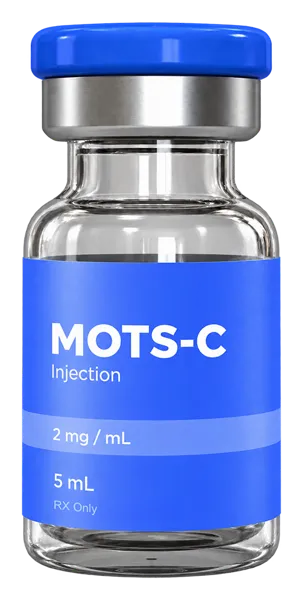
Compared with rapamycin, the research longevity peptides sit a rung lower on human evidence, resting almost entirely on animals and cell cultures. MOTS-C was first described as a “16-amino-acid peptide” encoded within “the mitochondrial 12S rRNA” that “regulates insulin sensitivity and metabolic homeostasis,” acting through the energy sensor AMPK in mice (Lee et al., 2015). A 2021 study built its “exercise peptide” reputation, reporting that “MOTS-c can significantly enhance physical performance in young (2 mo.), middle-age (12 mo.), and old (22 mo.) mice” and that “late-life initiated intermittent MOTS-c treatment (3x/week) can increase physical capacity and healthspan in mice” (Reynolds et al., 2021). Its human data amount to a biomarker observation, circulating MOTS-C rises with exercise, not a treatment result. Epitalon’s case is thinner and older: its anti-aging reputation traces largely to a 2003 experiment in which the peptide reactivated telomerase and lengthened telomeres in human fetal cells in a dish, which the authors said “indicates the possibility of prolonging life span of a cell population and of the whole organism” (Khavinson et al., 2003), a sentence written about cultured cells, not people. Our companion pillar on longevity peptides in 2026 walks through both in depth. The honest summary: interesting mechanisms, real preclinical signals, and no completed human longevity trial, a weaker human record than even rapamycin’s early trials.
Rapamycin vs longevity peptides at a glance
The table below sets the two side by side on the dimensions a buyer actually cares about, so approval status and evidence level are visible together rather than blurred by marketing. No row is a recommendation; rapamycin is a potent immunosuppressant with real side effects, and the peptides’ side effects are largely unstudied.
| Dimension | Rapamycin (sirolimus) | Longevity peptides (MOTS-C, epitalon) |
|---|---|---|
| What it is | Small-molecule mTOR inhibitor, an established prescription drug | Short synthetic/mitochondrial peptides |
| FDA status | Approved by the FDA for kidney-transplant rejection and LAM; longevity use is off-label | Not approved by the FDA for any use |
| Best animal evidence | Reproducible median/max lifespan extension in mice (NIA ITP, 2009 onward) | Mouse performance/healthspan (MOTS-C); no rodent lifespan trial for epitalon |
| Best human evidence | PEARL RCT (n=114, 48 wks): safe at low dose, primary visceral-fat endpoint missed, some secondaries | Exercise-biomarker observation only (MOTS-C); in-vitro telomerase (epitalon) |
| Proven to extend human lifespan/healthspan | No | No |
| Main practical risk | Real drug risks (immunosuppression, mouth sores, lipids), needs medical supervision | Thin human safety data; product quality varies by source |
The row that reframes the comparison is human evidence paired with risk. Rapamycin’s risks are well characterized and its benefit is still unproven in humans; the peptides’ benefit is even less established and their risks are largely unmeasured. Neither is a settled anti-aging therapy.
Side effects: rapamycin vs longevity peptides
The side-effect comparison is lopsided in an unexpected way: rapamycin’s side effects are well documented because it is an approved drug, while the peptides’ are largely unknown because nobody has run the trials. At transplant doses, the Rapamune label lists the most common adverse reactions, each seen in at least 30% of patients, as including peripheral edema, high triglycerides and cholesterol, high blood pressure, diarrhea, headache, anemia and urinary tract infections, and in the lung disease LAM the list starts with stomatitis (mouth sores). The label also warns that immunosuppression can increase susceptibility to infection. Longevity users take far lower, intermittent doses, and in the PEARL trial at 5 and 10 mg a week, adverse and serious adverse events were similar to placebo over 48 weeks. For MOTS-C and epitalon there is no equivalent: no completed human trial of either peptide has published a side-effect rate, so “no reported side effects” online means “not studied,” not “safe.”
What is the community saying?
In longevity communities, rapamycin and the peptides are often discussed as layers of the same routine rather than rivals. Our MOTS-C community tracker, drawn from public posts on X collected in July 2026, found users folding MOTS-C into wider stacks with NAD+, GHK-Cu and GLP-1 drugs and pairing it with SS-31, with some reporting more energy and others dismissing it as hype. The epitalon conversation centers on sleep, with mixed reports. Because people rarely change one thing at a time, these reports cannot show what any single compound did, which is the same gap the trials leave open.
Status: MOTS-C and epitalon: Not FDA-approved; sold by some telehealth providers as a compounded prescription. An FDA advisory committee reportedly voted in July 2026 to recommend allowing pharmacies to compound it; nothing has changed yet. (How peptide status works)
The honest bottom line for your longevity goal
If your real goal is a longer healthspan, neither option has earned a promise, but they fail that test in different ways worth naming. Rapamycin has the best animal lifespan data of any longevity candidate and a supervisable route through a prescriber, yet the human evidence is still early, a safe-but-primary-endpoint-missed trial, not proof of slower aging, and it is a serious immunosuppressant that belongs under medical supervision, never self-prescribed from an overseas source. The research peptides are earlier still, with no human trial showing a longevity benefit and little human safety data, which makes them a bigger unknown to take on alone. Our sourced comparison of NAD+ vs peptides for longevity and the money-page overview of longevity peptides in 2026 go deeper on the peptide side.
The genuinely useful next step is not picking a molecule off a forum but talking through your actual healthspan goal with a licensed provider who can look at your labs, your metabolic health, and your training, and tell you honestly where an off-label option like rapamycin might fit, where it clearly does not, and which evidence-based levers are likely to matter more. What no honest source should do is imply that either option has already been shown to slow human aging. To make that first conversation concrete, we distilled everything above into a free, one-page checklist of questions to bring to any provider.
Educational information only, not medical advice. Every evidence claim links to a primary or peer-reviewed source. Rapamycin is approved by the FDA only for the indications named above; its use for longevity is off-label and experimental. Updated October 12, 2026; the science in this area is moving, and we update these pages as it changes.
Sources (8)
Advertising disclosure: links marked "Paid link" go to Bodybuilding Peptides (trybbpeptides.com), an affiliate destination, and Healthspan Signal may earn a commission if you buy there. Our coverage is independent of that relationship, and nothing on this page is medical or legal advice.
 See it at Bodybuilding Peptides